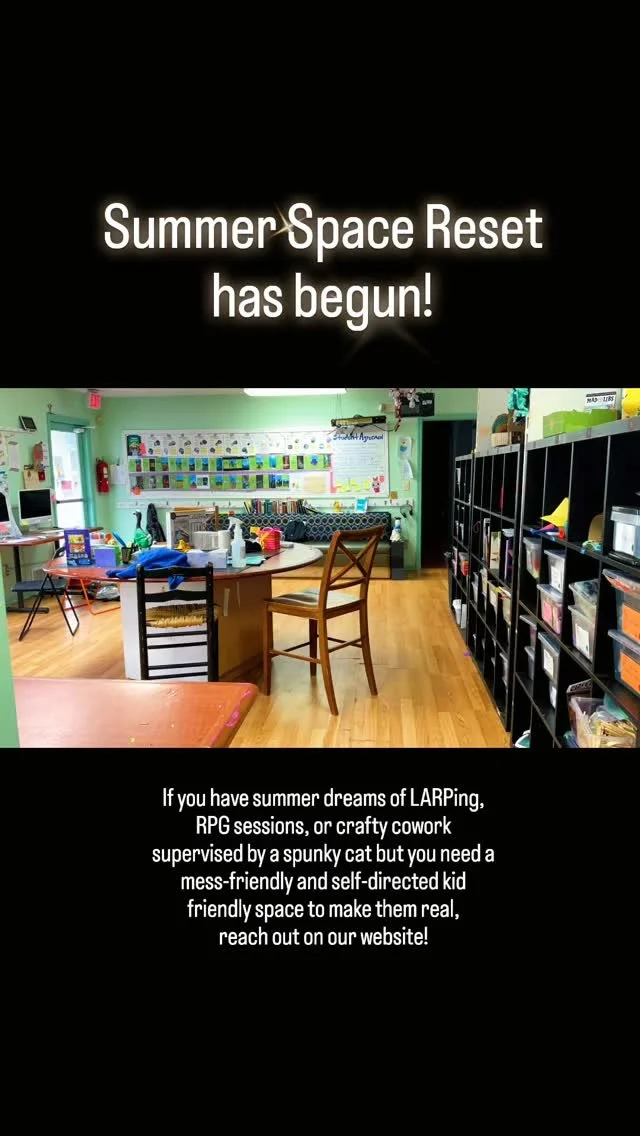

Heartwood ALC: a microschool for families who believe that education should be an expansive and joyful experience for all learners. Currently enrolling ages 8 - 16.
Our learning community’s foundation is a single, research-backed truth: children are born with an inherent drive to explore, create, and understand. When the context empowers them to follow this drive and adults support them in directing it intentionally, truly transformative learning becomes possible. At Heartwood ALC, we celebrate young learners, partner with families, and offer an invitation-full space to foster in our students the self-possession and agility they need to navigate an ever-evolving world.
We believe that when a child is free to explore, experiment, focus, and wonder, they become the architects of their own futures and capable life-long learners. We nurture this growth daily by leveraging:
Agency & Independent Thinking: Our students make meaningful, self-directed choices every day. By navigating their own paths, with supportive community members as collaborators and co-thinkers, they develop their autonomy, discernment, and sense of purpose.
An Ecosystem of Belonging: We’ve designed a non-competitive, age-mixed environment where students learn from and with one another. In this space, a social breakthrough, creative project, or new skill is celebrated as deeply as an academic "level-up."
Play for Life: We protect space for abundant free play. Play connects children to their bodies, their creativity, their peers, and their environment. Play is how children engage in meaning-making, develop resilience, and practice complex problem-solving and social skills. And, of course, play is fun! The shape of play changes as children grow, but its value in their lives doesn’t.
Real Responsibility: From co-designing the weekly schedule to resolving interpersonal conflicts together, our students are active stewards of their space. These practices engage them in developing not just as independent learners but as capable, considerate community members.
Our Clarkston microschool operates August through May, Monday through Friday, 9:00 am to 3:15 pm.
We currently have 5 open spots for our full time program and are accepting applications from the metro Atlanta area.
Hybrid programming with days on-site, online, and on expeditions locally is offered through our partnership with The Genius School. More information for hybrid students can be found here.
Heartwood utilizes a trans-disciplinary competency model which defines success through developing transferable skills and self-actualization. One of the things this means is that we’re not a low-demand space, but we are a low-arbitrary-demand space. We’re high-engagement, high-agency, and in many ways high-responsibility. Our students are busy developing transferable skills and self-actualization; our facilitators aim to support rather than interrupt that work.
There are many ways that people practice self-directed education. You can learn more about how we do it on our FAQ page.
Join us at Heartwood ALC, a space for the learner your child is already becoming.
A Typical Day, shared by our self-directed cat